

You Know Why
Sometimes there’s no choice but to do it yourself.
I grew up having very few expectations placed on me. Basically do well in school and don’t get into any major trouble. I’m smart enough, so that was easy. Skated through with A’s and B’s and knew enough to keep a safe distance between “real” trouble and getting caught. But I was never challenged. Never learned to challenge myself. Never pushed beyond easy and comfortable to accomplish things that build real confidence and character. As I grew up, got married, and started a family of my own, that showed in a big way. I had embedded in myself a nagging voice that asked of anything unpleasant or uncomfortable, “Why do I have to do it?”
That voice didn’t come from nowhere. It came from home — from the way I was raised, from a family of origin where effort beyond the minimum was optional and discomfort was something to be avoided rather than moved through. That mentality followed me into adulthood like a slow leak, quietly undermining everything I tried to build. My husband pointed out my disinclination toward effort early in our marriage. I didn’t take it seriously until after we had our two kids. As a stay-at-home mom, day-to-day tasks piled up to a point that was unbearable for everyone. He came home daily to messes, takeout, a stressed wife, and confused, uncooperative kids. I went to therapy.
Over those months I did a lot of complaining — my husband not helping when he got home, the kids not listening, laundry this, dishes that, blah blah blah. My therapist paused me and with five words deconstructed every excuse I had. She said, “You are not that special.” When the shock wore off, she explained. Everyone who has a home has to clean it. Everyone with food to eat has to cook and clean up after. If we have nice clothes, there’s laundry. The kids have toys and books — those things need to be kept tidy. If I’m going to stay home while my husband works, my role in the partnership is to handle the day-to-day so he can do his job. That hour changed my perspective forever, though I’ll be honest — it has still taken years of hard work to dismantle the habits. What it did do was set me on a track to start trying. A new perspective, a will to attempt things that were unpleasant or challenging, and a tremendous amount of encouragement from my husband led us to our farm in Peyton, Colorado. That’s where my story really shifted.
I still had no real confidence in myself. Ego, sure. Talk a big game, do the bare minimum — that was the precedent. But honest belief that I could accomplish important things? Severely lacking. The idea of a farm appealed to me. I love animals. I love quiet and nature and not being able to hear my neighbor leave for work at 3 a.m. So we bought 40 acres. My husband had big plans, but he also still had a day job, albeit remote. That meant the heavy lifting fell to me. And I squandered our first few years. Overwhelmed, disorganized, still very much engulfed by the “why do I have to do it” mentality — after all, it was his idea to have a farm. We completed a few projects like poultry houses and a garden thanks to his relentless weekend warrior diligence. After work, on breaks, every spare minute. I watched that and I saw two things clearly: my husband is composed of pure determination, and I actually wanted to see a farm come together too. I wanted more animals and the quiet, self-sustained life.
In Colorado, water is a big deal. Drought is more common than rainy years, and though we got snow on the plains, it’s not nearly enough to sustain pasture — 12 inches of snow equals maybe a little over an inch of rain. We relied on aquifers increasingly drained by urban sprawl. We had a short three months of growing season, with blizzards possible at the end of May and hard freezes in early September. We needed a greenhouse. We needed an aquaponic system. My husband planned the structure — a 40-foot shipping container with headers off the long side and nearly 800 square feet of greenhouse built out from it. Built to withstand sustained 30–40 mph winds and gusts over 80. Built to stand up to hail and blizzards dumping three feet of snow. And we were going to build it ourselves.
To say this undertaking overwhelmed me is an understatement. I shut down. My husband pushed. He pulled. He made demands. And he got me moving. He does that — he believes when I don’t, and he refuses to let that disbelief win. He emphasized the importance not just to our farm infrastructure, but to our kids’ homeschool education, our ability to grow our own food, to having a peaceful place for the two of us year-round. And critically, he emphasized the necessity of proving to our kids that facing challenges and trying things we aren’t sure we can do is not only possible, but the only way to succeed. He helped whenever he could, but this was the first major project that would be primarily built by me and our kids — 14 and 10 at the time. It took over a year with all of my figurative kicking and screaming, from laying the gravel foundation to a functioning greenhouse.
But I remember putting the last polycarbonate panel up. All four of us working together to slide it into the track, me climbing up on the roof and dangling somewhat precariously over the slanted side to get the upper screws, Alan using his height to secure the middle section I couldn’t reach from any direction. I remember how happy both kids looked when we stepped back. We went inside and felt the warmth increasing immediately — wind thwarted, sun shining bright. My husband was relieved. And I felt proud. Not cocky. Proud.

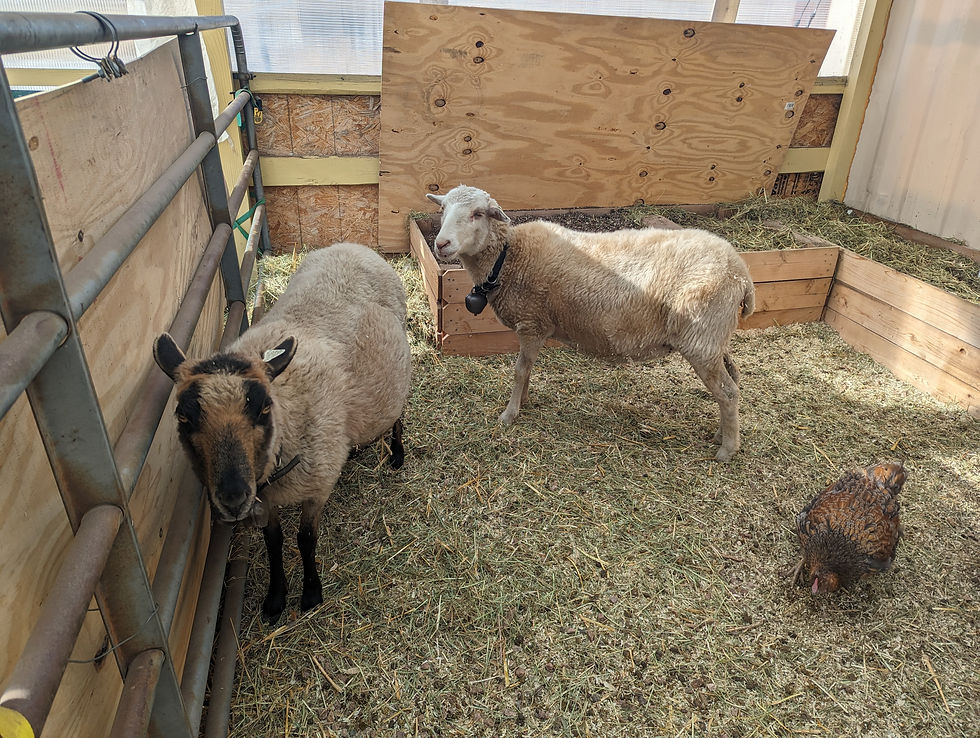
That was my turning point. The voice that screams, “Why do I have to do it?” got a little quieter that day. It got quieter every time I met a challenge with some semblance of tenacity, though it wasn’t a steady muffling. There were failures. I left too much unfinished when it was time to pick up our starter flock of sheep, and it landed on Scout’s young shoulders to do enough that they’d at least be secure upon arrival. It was far more than she should have been responsible for. The pen was secure when we got home, but it wasn’t what I had pictured — and the voice in my head turned on her. It wasn’t her fault. She did her best. The work should have been done well before the sheep were due. Why do I have to do it? Because I’m the mom. It’s my farm. I wanted the sheep. I did the research. I planned the pen. I have to do it because it is unfair, unrealistic, and flat-out wrong to expect anyone — especially my kids — to pick up the slack I laid down in front of them. Period. That was a hard lesson. One that took heartbreak, mindfulness, and real internalization to confront. Why me? Because I’m an adult, and this is how things get done.
The farm had a way of answering that question over and over again. Some young turkeys, laying too close to the fencing of their overnight enclosure, were attacked as they slept. I had to make the heartbreaking decision to cull the ones beyond help, then lead the family in cleaning and bandaging the remaining injured poults. Why? Because it’s inhumane to leave them suffering. Because they count on us for their lives. That attack exposed a flaw in our pen design and I had to repair it. Why me? Because I love our animals and didn’t want to lose any others. That was the deadliest attack we had on the farm. We lost six poults. It was a dirty, bloody, heartbreaking lesson. We hauled five-gallon buckets of water multiple times a day to multiple pens and paddocks during blizzards. Why do I have to do it? Because the animals need water, the troughs and hoses are frozen, and there is no other way. Do it or animals die. We urgently remodeled one side of the greenhouse into lambing quarters for two very pregnant ewes, then spent two nights sleeping out there on lamb watch when a January cold snap sent nighttime temperatures to -19, windchill driving them even lower. Why? Because we refused to risk having lambs freeze to death while we slept comfortable in our beds.
Alan lost his job in February 2024. By the last weekend in September, the two of us sat in the garage discussing options. We had been on the farm nearly eight years — most of that time spent dealing with the lackadaisical habits and wrong-headed thinking I had embodied and was actively passing on to the kids. The farm was not ready to run at a profitable scale. After accounting for every possible income stream, I told Alan I was ready to seriously consider moving to West Virginia, something I’d mentioned lightheartedly a few months earlier. He didn’t hesitate. He already knew Colorado was a challenge for farming and had been quietly considering other locations before pressure from my family and hesitation from me had anchored us to the property in Peyton.
That’s the other piece of this. My family of origin — that same wellspring of “why do I have to do it?” — had a long reach. Their resistance to change, their skepticism of big ideas, their comfort with small and safe had seeped into my own hesitation for years. Every time we had a chance to move boldly, that voice had company. It wasn’t just in my head — it was in the room, at the dinner table, on the phone. Untangling what was genuinely my own fear from what had simply been handed to me took time I didn’t fully appreciate we were losing.
We cleaned up the Colorado property, did some repairs, and listed the house by Halloween. Friends and family told us repeatedly it could sit for weeks or months before any serious interest. We believed it would sell. We loved it and trusted other people would too. It was under contract before Thanksgiving — faster than even I expected. I believe Alan always knew. Our buyer requested we close and vacate by December 20th. A month to tie up eight years of a life and move across the country.
Armed with a detailed checklist Alan built — covering flood plains, land grade, useful trees and shrubs, weather patterns, distance to towns, county regulations and zoning — our son, Buck, and I flew out for three very intense days and circled most of West Virginia. We called realtors for every listing, set up showings, asked for additional leads, and talked through exactly what we needed at every stop. We moved through Charleston to Beaumont, Parkersburg to Clarksburg, Fairview, and even a quick swing through a town called Looneyville — mostly for sport and unfortunately in the dark.
One realtor named Mike stood out. He was the listing agent on one of our properties, listened carefully to everything I told him we needed, and when our time in the state was nearly up, he called with a wildcard — another listing not far from the first. Our schedule only had room for one. He sent the link and told me that while the decision was completely mine, he had a feeling this new property might really suit us. Because he had been so genuinely invested in what we were doing, I trusted him. Buck and I met him at a 15-acre blank slate in Monongah. The dirt driveway was steep, muddy, and slick from fresh snow, but it leveled off just enough at the top to park. The land was densely wooded with mature trees, hilly but buildable, near the top of the mountain with no flood risk, and the ecosystem looked stable and established — no sign of people coming in, making a mess, and leaving. Town was 1.5 miles down the mountain. Privacy from neighbors, but close enough to walk over. Outside city limits, farm animals allowed.

And it was the only property that made Buck genuinely smile. Before we left Colorado, Alan had told him: you’re the man on this trip. Pay attention, look close, ask questions, help decide where we’re going to live. I asked Buck what he thought. He smiled bigger. “Is this the one?” “Yeah.”
We called Mike and made an offer. It was quickly accepted. We had a direction.
The weeks that followed were a controlled sprint. I bought an RV — a 2002 Fleetwood Bounder that Scout and I found after days on Facebook Marketplace and Craigslist, vetted by the expertise of an RV inspector we enlisted to teach us what to look for. It was listed a little higher than I wanted to pay, but it had everything we needed and showed no signs of water damage, electrical issues, or mechanical trouble. I drove it home from the town of Elizabeth to Peyton — the first and only time I’d drive it before it officially became our home. It rocked like a ship on rough water, every bump sending us bouncing half a block before settling back. But it accelerated well, stopped solidly, and could turn a surprisingly sharp corner. Buck named her Sheila.
Some of our animals were always destined for the table. With tremendous help from incredible new friends, we dispatched, processed, and froze two pigs, a cow, some poultry, and three sheep. The remaining animals were rehomed, with two exceptions: seven chickens — Scout’s rooster Pebbles, his hens, and Buck’s favorite hen now integrated under Pebbles’ watch — and Scout’s hard-earned Mangalitsa sow, Skipper. These indispensable family members would stay with neighbors in Colorado until we got settled, built them proper housing, and came back with a trailer.
Our belongings were drastically scaled back. What we absolutely needed went into the RV. A 10x10 storage unit held anything else that would make the journey eventually. The rest — from nearly 3,000 square feet of house — was sold, donated, or turned out to simply be trash. One of my biggest realizations through all of it: so much of what we owned, we only bought because we had room for it. Walls full of art, bathrooms full of products, a kitchen full of gadgets, drawers full of junk. Very little of it had actually added value to our lives.
We left the evening of December 20th, 2024 — barely making our deadline — in Sheila. Our family of four, two dogs, three cats, and a rabbit, heading east.
This past December, our second winter with Sheila as the buffer between us and West Virginia’s cold, the furnace started to struggle. It would squeal when it kicked on — not in an “interesting” way, but in a shrill, ear-piercing, something under enormous stress may ignite and kill us all kind of way. The blower motor needed to be replaced. I ordered the part, set up our backup heater — a Big Buddy propane burner — and while I waited for the motor to arrive, I researched. Read the RV manual. Studied furnace schematics and compared them to what I could actually see in ours. Watched YouTube videos of people who’d faced the same issue and made the repair. Bought the tools I thought I’d need. By the time the motor arrived, I was confident I could do it. It seemed to be approximately a four-hour job.
It was not a four-hour job. The components didn’t quite match the pictures and videos, even those in our own manual. Subtle differences that could not be ignored. No set screws where I expected them — pipe clamps instead, a kind I’d never seen before. Wiring colored differently. More holding the system together than the diagrams suggested. So I tracked down the screws, found the connections, took pictures as I went, tracked the wires, figured out the clamps, and changed out the motor. Instead of four hours, it took three days. I tore apart more than I needed to looking for one screw I couldn’t locate. I bought tools I didn’t end up needing and had to go buy things I hadn’t anticipated. I tore up my knuckles on sheet metal and learned things about RV ductwork I never expected to know.
There was one moment — standing outside, fingers freezing, staring somewhat blankly into the open abyss of the furnace — when I heard it. My own voice. “Why do I have to do this?” But this time it was quiet. Just a whisper making an inquiry, not a scream demanding someone else handle it. This time it was only a reminder: we’re here. We’re off-grid. We have to be careful with our budget. RV techs are expensive and even more so when they have to come to you. We need heat. We need to thaw the plumbing. We need to get our home back in functioning order. I knew exactly why I needed to do it — and instead of that voice creating chaos, it created resolve.
A steadfastness built on a farm foundation. Self-reliance I only have because of what I learned getting dirty, facing new challenges, and understanding what it really means to take care of what’s yours. The farm gave me that. My husband never stopped believing I could get there, even when I didn’t. And slowly, one uncomfortable, unpleasant, necessary thing at a time, the voice that once paralyzed me learned a new answer.
You know why. Now get it done.

Comments